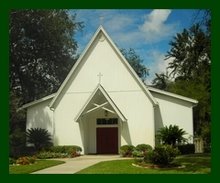
Well, I've now begun my mentoring experience at San Jose Episcopal. Their rector (and my mentor) is Father Steph Britt. He's in his late thirties and loves ministry. He's been at SJE a few years and the folks there are very fond of him. The parish is very outgoing, warm and growing. They've added forty new families to an already healthy church since Father Britt arrived. I've also met their Deacon, Chris Sorey, Sue and Susan from the office, Molly their youth programs director, and Bill, their talented music director. The parish has a day school and the school and church combined share a lovely property on one of the more prosperous boulevards in Jacksonville.
Going to a different church is different! I have grown so accustomed to worship and community with the good people of St. Andrew's. I cannot help but think that the diocese started the mentoring program so that potential seminarians would get a taste of leaving their home churches before they actually committed to selling their homes and moving away for school. The good thing is that the people of San Jose are so welcoming that I know I will feel at home before too long. I am inspired by the example of St. Paul as he travelled; getting to know and care for many church families. Last Sunday was my first at SJE and I attended both services. In the future I will get to experience the responsibilities of serving at the altar, but for this first Sunday I was simply a visitor. I think this was the right way to start. Father Britt introduced me in each service and many, many people introduced themselves, before and after the services and during their delicious breakfast. I even received a visitor welcome packet with trail mix that I just finished eating this morning.
Tonight I'll be back at St. Andrew's trying to help set next year's budget. I'm sure that pledges will have been impacted by the economy, but I know God's blessings will continue to shower on both of my churches.
Jon
Wednesday, December 3, 2008


Tuesday, October 7, 2008
Mentoring starts soon!
The next and last part of discernment is ahead of me and starts in a few weeks. I will be working with the priest at a local parish in kind of an on the job training mentorship. This should be fun. I will vest (dress up in fancy altar clothes) for every service, go to vestry and liturgy commission meetings, help plan worship services, be present during the preparations for baptisms, weddings, and funerals, learn about picking music, etc. I've only ever done any of these activities at my home parish, among friends , so this experience will be a lot like when a priest moves to a new parish as an ordained leader, but without the pressure (yeah right!).
My informal Christian training is also starting to take on a new flavor. By this I mean the daily training that Jesus is providing me through prayer and reading scripture. I am happily drifting a bit away from doing things out of a sense of duty and towards doing them for the joy of the activitiy. Especially scripture has become a lot more attractive in it's own right. I guess there are millions of people who are drawn to the Bible like magnets, but it isn't always like that for me. Recently I was reading in Isaiah about the way that Israel turned away from and betrayed God. You can see right there in the passages all the fraility of mankind and our tendencies toward self absorption leading into sin and then subsequent self loathing. If we could be happy thinking about ourselves all the time then I suppose I'd be a lot happier than I am!
My informal Christian training is also starting to take on a new flavor. By this I mean the daily training that Jesus is providing me through prayer and reading scripture. I am happily drifting a bit away from doing things out of a sense of duty and towards doing them for the joy of the activitiy. Especially scripture has become a lot more attractive in it's own right. I guess there are millions of people who are drawn to the Bible like magnets, but it isn't always like that for me. Recently I was reading in Isaiah about the way that Israel turned away from and betrayed God. You can see right there in the passages all the fraility of mankind and our tendencies toward self absorption leading into sin and then subsequent self loathing. If we could be happy thinking about ourselves all the time then I suppose I'd be a lot happier than I am!
Wednesday, June 25, 2008
Weekly Letter 062908
This Sunday’s Old Testament lesson begins with the words “God tested Abraham”. And what a severe test it was! I am wholly repulsed whenever I read this section of Genesis to hear of a God that would require his servant to sacrifice the life of his own child. But this scripture is so tough to swallow that I end up reading it more than once, and I’m always drawn to Abraham’s assurance when Isaac asks about the sacrificial animal - “God himself will provide the lamb”.
Did Abraham know what would happen? Did he at least suspect? Do I have that kind of obedience to God? Will I do as I am told by God… no matter what?
The journey from the dusty desert rock that Isaac was bound upon to the site of the cross at Golgotha is less than 40 miles, but over 1,600 years separated the two events. In Abraham’s anguish at the loss of his child, perhaps we can understand our God a little better. In Abraham’s obedience to God we can certainly understand our savior much better. As Christians let us never forget that when the time really came for a son to be sacrificed, it was the God’s own Son and the sacrifice was for us.
Did Abraham know what would happen? Did he at least suspect? Do I have that kind of obedience to God? Will I do as I am told by God… no matter what?
The journey from the dusty desert rock that Isaac was bound upon to the site of the cross at Golgotha is less than 40 miles, but over 1,600 years separated the two events. In Abraham’s anguish at the loss of his child, perhaps we can understand our God a little better. In Abraham’s obedience to God we can certainly understand our savior much better. As Christians let us never forget that when the time really came for a son to be sacrificed, it was the God’s own Son and the sacrifice was for us.
Monday, May 19, 2008
The Discernment Process
The process of becoming a priest in the Episcopal Diocese of Florida is pretty long and arduous, but if the call is true, then you feel compelled to dig in and press forward, no matter what. A typical "discernment" process takes about 2-3 years from the time that you express your interest to the diocese until you are actually ready (if you make it!) to set off for seminary. In my case I began my discernment in the fall of 2005 and, God willing, I will be in seminary in fall 2009.
The discernment process is outlined in a 50 page booklet on our diocesan website, but the quick details are as follows:
6-12 months of monthly meetings with your parish priest to ask questions and discuss the call. This time includes lots of reading (scripture, of course and there is a diocesan provided book list – your priest will also suggest readings).
6-12 months of meetings with a congregational discernment committee – these are folks from your own parish that meet with you on a regular schedule. Together you explore the call using guidelines and topics provided by the diocese.
6 months of mentorship with a local parish other than your home parish. This is like on the job training, with you shadowing a priest from Advent through Easter. You are encouraged to participate in all manner of clerical activity, such as preparation for Sunday services, baptisms, funerals, vestry meetings, parish finances, social activities of the parish, etc.
The time it takes depends on the person and the circumstances. I was occasionally discouraged that it is such a long process, but mostly I have been very grateful.
First, I have had a lot of growing to do and I needed time to do the growing. Wanting to become a priest forces you to re-examine all of your relationships, with your wife, your kids, your church family and most importantly, with God. I needed to know that I wasn’t going to risk my family and my current career on a feeling or a whim, this had to be concrete.
Second, a few years of discernment gives your wife and kids time to get used to the idea of selling your home and moving to seminary – this is not an easy thing to ask your family to do. My kids are young, so their sense of adventure trumps their fear of leaving. Still, I’m sure it will be tough to leave their friends, our church, and their grandparents. My wife is an incredible Christian educator and youth minister at our home parish and she has struggled most with moving away. She has rightfully insisted that our three years at seminary be meaningful and rewarding for both of us (right now it looks like she will pursue her masters in theology while I pursue my masters in divinity). Finding the best outcome among many possibilities has made us much closer.
Finally, the discernment period provides many practical benefits. By summer of 2009 we will be completely debt free (very important for seminarians!). My home parish has been very involved in the process and I know that we will be able to rely on our church family while at seminary. We have had time to prepare our home for sale. I also need time to study for the GRE and have very consciously become a student again – reading and writing all the time in preparation for formal studies.
The discernment process is outlined in a 50 page booklet on our diocesan website, but the quick details are as follows:
6-12 months of monthly meetings with your parish priest to ask questions and discuss the call. This time includes lots of reading (scripture, of course and there is a diocesan provided book list – your priest will also suggest readings).
6-12 months of meetings with a congregational discernment committee – these are folks from your own parish that meet with you on a regular schedule. Together you explore the call using guidelines and topics provided by the diocese.
6 months of mentorship with a local parish other than your home parish. This is like on the job training, with you shadowing a priest from Advent through Easter. You are encouraged to participate in all manner of clerical activity, such as preparation for Sunday services, baptisms, funerals, vestry meetings, parish finances, social activities of the parish, etc.
The time it takes depends on the person and the circumstances. I was occasionally discouraged that it is such a long process, but mostly I have been very grateful.
First, I have had a lot of growing to do and I needed time to do the growing. Wanting to become a priest forces you to re-examine all of your relationships, with your wife, your kids, your church family and most importantly, with God. I needed to know that I wasn’t going to risk my family and my current career on a feeling or a whim, this had to be concrete.
Second, a few years of discernment gives your wife and kids time to get used to the idea of selling your home and moving to seminary – this is not an easy thing to ask your family to do. My kids are young, so their sense of adventure trumps their fear of leaving. Still, I’m sure it will be tough to leave their friends, our church, and their grandparents. My wife is an incredible Christian educator and youth minister at our home parish and she has struggled most with moving away. She has rightfully insisted that our three years at seminary be meaningful and rewarding for both of us (right now it looks like she will pursue her masters in theology while I pursue my masters in divinity). Finding the best outcome among many possibilities has made us much closer.
Finally, the discernment period provides many practical benefits. By summer of 2009 we will be completely debt free (very important for seminarians!). My home parish has been very involved in the process and I know that we will be able to rely on our church family while at seminary. We have had time to prepare our home for sale. I also need time to study for the GRE and have very consciously become a student again – reading and writing all the time in preparation for formal studies.
Wednesday, May 14, 2008
Net Article, May 25 2008
Because you gave Jesus Christ, your only Son, to be born for us; who, by the mighty power of the Holy Spirit, was made perfect Man of the flesh of the Virgin Mary his mother; so that we might be delivered from the bondage of sin, and receive power to become your children. BCP p. 378
Dear Brothers and Sisters,
One of Anglicanism’s greatest strengths is our incarnational theology. Simply stated we believe that God became man in the person of Jesus Christ – He was and is, simultaneously, God and man. The Nicene Creed, composed in the fourth century during two councils of the early Catholic (universal) church, is probably our finest statement of this way of believing in God. The early church had to reconcile competing interpretations about the nature of Jesus and his relationship to God the Father. The result of this reconciliation of thought, faith and experience is a creedal statement that continues to strengthen and bind together our Church 1600 years later.
The truth of incarnational theology is its recognition that mankind, on its own, will never be able to solve the dilemma of human evil and moral weakness. In coming to earth Jesus affirmed that only through our relationship with our Father in Heaven would we be able to be the men and women God intends us to be. By the example of His life, death and resurrection, Jesus showed us what a sin-less life looked like. By His devotion to prayer and community He showed us how righteous people should live and treat each other. And by His death on the cross He showed us true obedience to God’s will and also how far God would go to save us.
Jon
Dear Brothers and Sisters,
One of Anglicanism’s greatest strengths is our incarnational theology. Simply stated we believe that God became man in the person of Jesus Christ – He was and is, simultaneously, God and man. The Nicene Creed, composed in the fourth century during two councils of the early Catholic (universal) church, is probably our finest statement of this way of believing in God. The early church had to reconcile competing interpretations about the nature of Jesus and his relationship to God the Father. The result of this reconciliation of thought, faith and experience is a creedal statement that continues to strengthen and bind together our Church 1600 years later.
The truth of incarnational theology is its recognition that mankind, on its own, will never be able to solve the dilemma of human evil and moral weakness. In coming to earth Jesus affirmed that only through our relationship with our Father in Heaven would we be able to be the men and women God intends us to be. By the example of His life, death and resurrection, Jesus showed us what a sin-less life looked like. By His devotion to prayer and community He showed us how righteous people should live and treat each other. And by His death on the cross He showed us true obedience to God’s will and also how far God would go to save us.
Jon
Thursday, May 8, 2008
Net Article May 4, 2008
I am the Senior Warden at St. Andrew's and one of the many perks of that role is that I get to write a weekly article for our Sunday service bulletin. I will probably publish all of these on the blogsite.
When it was evening on that day, the first day of the week, and the doors of the house where the disciples had met were locked for fear of the Jews, Jesus came and stood among them and said, "Peace be with you." After he said this, he showed them his hands and his side. Then the disciples rejoiced when they saw the Lord. Jesus said to them again, "Peace be with you. As the Father has sent me, so I send you." When he had said this, he breathed on them and said to them, "Receive the Holy Spirit. If you forgive the sins of any, they are forgiven them; if you retain the sins of any, they are retained." John 20: 19-23
My Dear Brothers and Sisters in Christ,
Today’s gospel message is so incredible; look at the mighty power of this short section of scripture! On the first day of the week the disciples were hiding – hiding for fear of the Jews! Next Jesus passes bodily through a locked door… Then, in characteristic good humor, he bids the disciples ‘Peace’. After that they see his wounds and they know the truth of the resurrection of the body. Since the disciples are stunned into silence, Jesus greets them again: ‘Peace be with you’. They come to their senses. Immediately he tells them – ‘As the Father has sent me, so I send you.’ --Jesus has the same expectations of his disciples (us!) that God had of him… this means we will have to be witnesses to God’s glory. We have to sacrifice and be humbled. We are expected to die to sin as Christ himself died. We are children of God...
But how can God expect these things and more from mere humans? The key is the final sentence – he breathed on them and said ‘Receive the Holy Spirit.’ Through grace we are all heirs to His Kingdom. We are the fruit of the living vine, with roots which reach beyond time, to that breath of life. When Christ breathed on his disciples, he breathed on us – ‘Receive the Holy Spirit’.
When it was evening on that day, the first day of the week, and the doors of the house where the disciples had met were locked for fear of the Jews, Jesus came and stood among them and said, "Peace be with you." After he said this, he showed them his hands and his side. Then the disciples rejoiced when they saw the Lord. Jesus said to them again, "Peace be with you. As the Father has sent me, so I send you." When he had said this, he breathed on them and said to them, "Receive the Holy Spirit. If you forgive the sins of any, they are forgiven them; if you retain the sins of any, they are retained." John 20: 19-23
My Dear Brothers and Sisters in Christ,
Today’s gospel message is so incredible; look at the mighty power of this short section of scripture! On the first day of the week the disciples were hiding – hiding for fear of the Jews! Next Jesus passes bodily through a locked door… Then, in characteristic good humor, he bids the disciples ‘Peace’. After that they see his wounds and they know the truth of the resurrection of the body. Since the disciples are stunned into silence, Jesus greets them again: ‘Peace be with you’. They come to their senses. Immediately he tells them – ‘As the Father has sent me, so I send you.’ --Jesus has the same expectations of his disciples (us!) that God had of him… this means we will have to be witnesses to God’s glory. We have to sacrifice and be humbled. We are expected to die to sin as Christ himself died. We are children of God...
But how can God expect these things and more from mere humans? The key is the final sentence – he breathed on them and said ‘Receive the Holy Spirit.’ Through grace we are all heirs to His Kingdom. We are the fruit of the living vine, with roots which reach beyond time, to that breath of life. When Christ breathed on his disciples, he breathed on us – ‘Receive the Holy Spirit’.
Subscribe to:
Posts (Atom)